




Setup a Printer
Check Compatibility
Search for your printer's manufacturer and model on OpenPrinting.org to see which drivers your printer requires and how they perform.
Note that some printers on the list require proprietary software to function properly (but are compatible with GNU/Linux systems using proprietary drivers), so be careful.
h-node is another useful resource for finding printers compatible with completely free systems like Trisquel.
Please add your printer model to the website if it is compatible with Trisquel.
Installation
Install your printer driver.
Some common drivers, such as HPLIP and Ghostscript, are included by default in the Trisquel installation.
Open the default printer manager in the Main Menu (System → Administration → Printer).
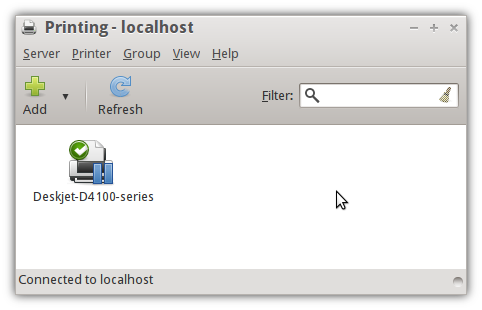
Connect your printer to your computer. The printer should be detected and appear in the main window.

Configuration
- Open the printer's Properties menu by right-clicking on the connected printer and clicking Properties.
- In the Policies section, select Enabled and Accepting Jobs, and Shared if you want to share the printer on a network.
- In the Access Control section, you can allow or deny access to other users.
- In the Printer Options section, the default settings are probably best, but if you want to save ink, you can change the print mode from Normal (grayscale) to Draft.
- The Job Options section allows you to change how the printer handles print jobs. It's generally best to leave the default settings.
- Finally, click the Print Test Page button under the Settings section to print a test page. Checking Your Cartridge Levels
You'd like to be able to check the ink levels in your cartridges.
There are several ways to do this.
The easiest method is using the "Ink Levels" section of your printer's Properties, but some printers may not report ink levels correctly.
Another option is to use the graphical tool called hp-toolbox.
Go to this website and see if your model (it should be a Canon, Epson, or HP printer) is supported by libinklevel, the library used by Inkblot.
Most HP and Epson printers should transmit their ink levels in recent versions of libinklevel.
If the printer is HP
The first thing you need to do to configure an HP printer on GNU/Linux is to install HP's printer manager, HPLIP, which is open source.I can do this with:
$ sudo apt install hplip hplip-guiNext, check the HP printer list to see if your model requires proprietary firmware to have all the features configured.
This is the website where the list is located:
https://developers.hp.com/hp-linux-imaging-and-printing/supported_devices/index
Looking at the list, your multifunction printer model is not currently available, so it will require a recent version of the HPLIP driver, which must be updated.
However, it's quite likely that the printer uses the DeskJet 3630 series HPLIP driver because many printers don't require proprietary firmware (or "driver plug-in," as HP calls it) to work with HPLIP version 3.15.6 or later.
On GNU/Linux, you can view the **ink levels of an HP printer from the terminal** using the tools in the HPLIP package, which is HP's official printer support system.
1. View ink levels with `hp-toolbox` First, make sure the printer is connected and run:
$ hp-setup
$ hp-toolbox
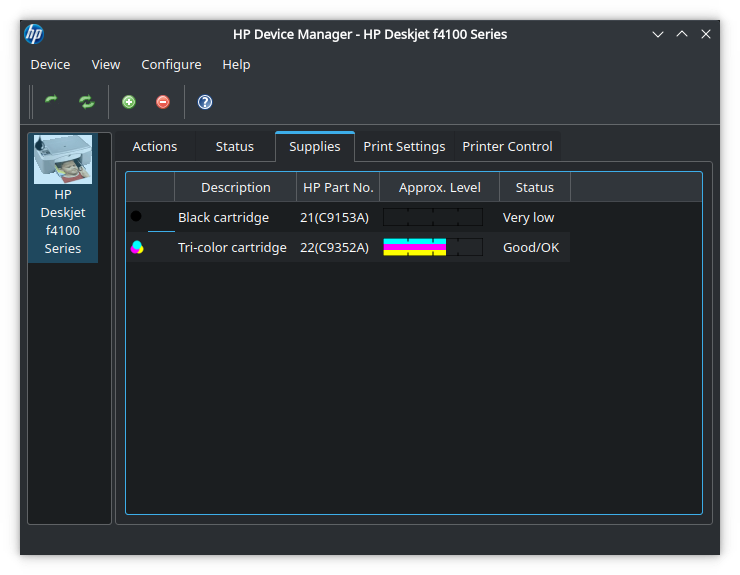
$ hp-infoThis will display device information, including something like:
Supply levels:
Black cartridge: 65%
Tri-color cartridge: 40%
If you have multiple printers, you can specify which one to use:
$ hp-info -d hp:/usb/Printer_Name2. View status with `hp-status` You can also use:
$ hp-statusThis command displays:
printer status
ink or toner levels
print jobs
Example output:
Device: HP DeskJet 2600
Black: 70%
Color: 45%
Status: idle
3. Verify that HPLIP is installed If the commands are not present, Install the package:
$ sudo apt install hplipThen try the commands again. 4. List detected printers To see the device address:
$ hp-probe -b usbor
$ lpstat -p


